

Dreams, Longing, and Beyond
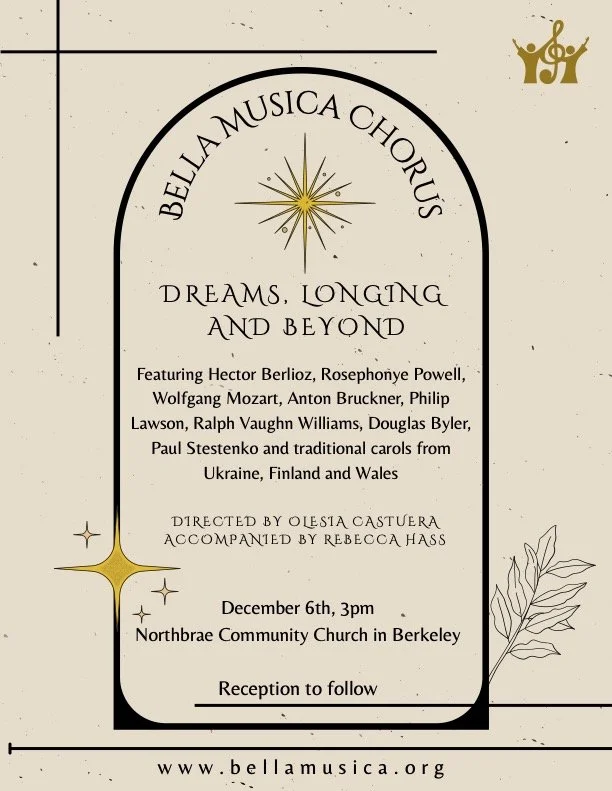
Saturday, December 6, 2025, 3:00 p.m.
Northbrae Community Church
941 The Alameda, Berkeley CA 94707
Tickets at the door. $20 suggested donation, sliding scale.
Reception following performance.
Enjoy a delightful afternoon of new and well-known works, including Mozart’s “Ave Verum Corpus,” “Magnificat” by Ralph Vaughn Williams, “Tota Pulchra Est” by Anton Bruckner, “To Sit and Dream” by Rosephanye Powell, “O Nata Lux” by Douglas Byler, “All Is Miracle” by Kyle Pederson, and “A Spotless Rose” arranged by Herbert Howells. In the spirit of the season, we will also perform traditional Ukranian carols, Paul Stetsenko’s “A New Year’s Carol” (based on Walter de la Mare’s “Tom Tiddler’s Ground”), “Gaudete” (edited by Gary Cannon), and Kenneth Leighton’s haunting “Lully, Lulla, Thou Little Tiny Child.”
Audience members will be invited to join us to sing Britten’s popular “New Year’s Carol.”
-
To Sit and Dream, Rosephanye Powell
Veni, Veni, Emmanuel, arr. by Philip Lawson
Magnificat, Ralph Vaugh-Williams
Tota Pulchra Es, Anton Bruckner
O Nata Lux, Douglas Byler
Gaudete, anonymous
A Spotless Rose, Herbert Howells
Shcho To Za Predyvo (Traditional Ukranian Carol)
Prechystaya Diva, Traditional Ukranian Carol
The Shepherds’ Farewell, Hector Berlioz
Lully, Lulla, Thou Little Tiny Child, by Kenneth Leighton
Ave Verum Corpus, Mozart
A New Year Carol, Benjamin Britten
A New Year Carol, Paul Stetsenko
All Is Miracle, Kyle Pedersen
-
Rosephanye Dunn Powell (b. 1962) received music and education degrees from Alabama State University, Westminster Choir College, and Florida State University. Compositions include sacred and secular works for mixed, women’s, and men’s choruses, and for children’s voices. Her style of composition is characterized by heartfelt melodies, strong rhythmic emphasis, rich harmonies (often derived from African-American popular styles), and varied vocal textures, including counterpoint. With words from a poem by Langston Hughes, To Sit and Dream beckons us to reach toward the dream of a better world. Set with a lush jazz-influenced harmonic palette, the ethereal and dreamy quality makes this an interesting and musically sensitive work.
Philip Lawson (b. 1957) is a British choral conductor, composer and arranger. For eighteen years he was a baritone with the King’s Singers, serving as the group’s principal arranger for fifteen years. He was not from a musical family but a chance meeting introduced him to the boys’ choir of Worth Church which sparked his interest in music. He went on to study music at the University of York and to sing counter-tenor in the choir of York Minster. Lawson is also a composer of choral music. Veni, Veni Emmanuel is a setting of a traditional Latin text, with origins in monastic life in the 8th or 9th century. The melody is from 15th century France.
Ralph Vaughn Williams (1872-1958) is perhaps Britain’s most important and influential composer of the first half of the 20th century. Prolific in most musical genres, he was an active composer from his student days right up until his death in 1958, at the age of eighty-six. He composed dozens of works that are part of the core repertory of British music of the last century, including the important series of nine symphonies. He lived long enough to have written in a number of rather different styles, all of them authentic and reflective of his changing interests and the times. He was born into an educated, upper middle class family, attended Cambridge University, and studied with eminent musicians and scholars, including a stint with Maurice Ravel. Among his early close friends and fellow students were such luminaries as Bertram Russell, Leopold Stokowski, and Gustav Holst.
Magnificat, composed in 1932, is a fascinating and unconventional setting of the biblical text traditionally associated with the Virgin Mary’s song of praise. Unlike many settings of the Magnificat, which emphasize grandeur and jubilation, Vaughan Williams imbues his work with an introspective and, at times, haunting quality. This unique approach reflects his inclination to explore unorthodox interpretations of sacred texts, blending reverence with a profound sense of humanity.
Josef Anton Bruckner (1824 – 1896) was an Austrian composer, organist, and music theorist best known for his symphonies, masses, Te Deum and motets. The first are considered emblematic of the final stage of Austro-German Romanticism because of their rich harmonic language, strongly polyphonic character, and considerable length. Bruckner’s compositions helped to define contemporary musical radicalism, owing to their dissonances, unprepared modulations, and roving harmonies.
Tota pulchra es is a sacred motet composed in 1878, from a 4th century prayer. With its tenor solo and sparing use of the organ, it is one of the five antiphons for the psalms of Second Vespers for the Feast of the Immaculate Conception. With modal qualities reminiscent of Gregorian chant, it is structured as a dialogue between the tenor soloist and chorus.
Douglas Byler (b. 1988)is a composer from Virginia’s Shenandoah Valley. He received music and composition degrees from James Madison University and Westminster Choir College in Princeton, NJ. O Nata Lux is a Latin hymn originally set to music in the 16th century by Thomas Tallis. Expressive and sophisticated, Byler’s setting is bright and lyrical, with a soaring melody that expands and builds throughout the piece.
Herbert Howells (1892–1983) was born in Gloucestershire, the youngest of six children. He became an organ student at Gloucester Cathedral, but changed his focus after hearing the premiere of Fantasia on a Theme by Thomas Tallis, conducted by composer Ralph Vaughan Williams. Howells went on to compose in various mediums: vocal, choral, chamber music and orchestra.
A Spotless Rose is one of Howells’s most well-known and enduring works, a tender unaccompanied choral piece that encompasses much of Howells’s early choral writing and points towards the glories of his later Collegium Regale and beyond. It is beautiful yet understated, succinct yet not laconic, poised but not mannerist – a triumph of poignant and powerful word setting.
Gaudete is a sacred Christmas carol, thought to have been composed in the 16th century. It was published in Piae Cantiones, a collection of Finnish/Swedish sacred songs published in 1582 in the North German city of Greifswald. No music is given for the verses, but the standard tune comes from older liturgical books. There is a known entry from around 1420 in the Hussite Jistebnice hymnal (Jistebnický kancionál).
The Latin text is a typical medieval song of praise, and follows the standard pattern for the time – a uniform series of four-line stanzas, each preceded by a two-line refrain (in the early English carol this was known as the burden). Carols could be on any subject, but typically they were about the Virgin Mary, the Saints or Yuletide themes.
Ukrainian Carols:
Scho to za Predyvo (What a Miracle), was composed by Vasyl Barvinsky, a Ukrainian composer, pianist, conductor, teacher, and musicologist . One of the first Ukrainian composers to gain worldwide recognition, his pieces were published in Austria, the US and Japan. In the early 1900s, he directed the Lysenko Higher Music Institute in Lviv and was well respected in his field. In 1948, he was mysteriously arrest by the Soviet Union secret police, sentenced to 10 years in gulags in Siberia, meanwhile his manuscripts were destroyed. He tried to recreate many of the pieces and luckily, “Shcho to za predyvo” and several other works of his had been performed and published before his exile and thus survived.
Prechystaya Diva is a Ukrainian folk Christmas folk, translated to “Immaculate Virgin.” This popular arrangement was created by the group Pikkardiyska Tertsiya (Піккардійська терція), translated to Picardy Third. They began as a male vocal quartet in the city of Lviv in 1992, focusing on Ukrainian folk songs. Eventually they grew to 6 members, continuing to sing folk songs as well as liturgical music and pop music. They’ve recorded six records and toured all over Ukraine, the US and parts of Europe and collaborated with other artists at various festivals and projects. This arrangement is one of their most valuable works.
Hector Berlioz (1803-1869) Was a French Romantic composer who shaped and pushed the boundaries of western art music both within and beyond his lifetime. His works are often monumental in their ambitions and scale as well as their emotional outpourings. Berlioz was not a composer to do things by halves: he was a man of extreme passion and powerful vision with an extraordinary ability to convey this through music.
“The Shepherds’ Farewell” was originally written as an organ piece for a friend, which he later fleshed out into a full oratorio on the childhood of Christ. Berlioz first had the chorus performed under false pretenses, passing it off as the work of an imaginary 17th-century composer “Ducré.” He was gratified to discover many people who hated his music were taken in and praised it, one lady even going so far as to say, “Berlioz would never be able to write a tune as simple and charming as this little piece by old Ducré.”
Kenneth Leighton (1929 – 1988) was a British composer and pianist. He came from a working-class industrial town in Yorkshire and received early recognition for his musical ability. He composed church and choral music, pieces for piano, organ, cello, oboe and other instruments, chamber music, concertos, symphonies, and an opera. He had various academic appointments in the Universities of Leeds, Oxford and, primarily, Edinburgh.
“Lully, Lulla, Thou Little Tiny Child” (also known as “The Coventry Carol”) was originally written by Robert Croo in1534 as part of the Pageant of the Shearmen and Tailors. This was one of ten plays performed at stations around the city of Coventry by various guilds on the feast of Corpus Christi, each telling stories from the life of Christ. Leighton’s setting of the text …
W.A. Mozart (1756 – 1791) was a prolific and influential composer of the Classical period. Despite his short life, his rapid pace of composition and proficiency from an early age resulted in more than 800 works representing virtually every Western classical genre of his time. Many of these compositions are acknowledged as pinnacles of the symphonic, concertante, chamber, opera, and choral repertoires. Mozart is widely regarded as one of the greatest composers in the history of Western music.
Ave Verum Corpus is a short Eucharistic hymn expressing reverence for the body of Christ, dating from the 13th century. It has been set to music by many composers. In Mozart’s setting of the text, the music evokes feelings of the eternal and infinite, as well as a taste of death. Despite the personal challenges he was facing at the time, including failing health, the piece achieves a sense of peace and tranquillity.
Benjamin Britten (1913-1976) was one of the last century’s most respected composers, and unquestionably the most influential and admired British composer from WW II until his death in 1976. Fantastically gifted from an early age, he was blessed with the early attainment of an authentic personal “voice” in his musical style. That style was at once perceived as modern, fresh, and non-derivative—and yet generally accessible and popular with the broad public for art music. His works include vocal music, opera, orchestral and chamber music. The day of his birth coincides with the feast day of Saint Cecilia, patron saint of music.
A New Year Carol is the title of a folk song of Welsh origin traditionally sung in New Year celebrations, and associated with a New Year’s Day custom called dwr newy, (new water) involving sprinkling people with water newly drawn from a well. Additional verses include imagery the meaning of which is somewhat mysterious, and the song concludes with verses in which the new year is welcomed through the East gate and the old year dismissed though the West gate.
Kyle Pederson (1971) is a Minneapolis-based composer, lyricist, pianist, and educator.
He enjoys working at the intersection of the sacred and secular, and his lyrics and music invite the choir and audience to be agents of hope, grace, and compassion in the world. Pederson was awarded the American Prize in Choral Composition in 2019, and the Genesis Prize by the American Choral Directors Association in 2020. His music resonates for its “evocative use of harmony, melody, rhythm and texture”– and is “incredibly inspirational, moving, and spiritual” (American Prize).His work is commissioned, performed, and recorded by community, school, and professional choirs around the world.
About All is Miracle: “There are only two ways to live your life. One is as though nothing is a miracle.The other is as though everything is a miracle.” (Attr. Albert Einstein) Although attribution to Einstein is debated, the perspective is powerful. It encourages us to look at the world through wonder-tinted lenses-seeing both the magnificent and seemingly mundane coursing with sacred energy. Omnia mirabilia…all is miracle. – Kyle Pederson
-
Translations
O come, O come, Emmanuel
Veni veni, Emmanuel
captivum solve Israel,
qui gemit in exsilio,
privatus Dei Filio.
Refrain:
Gaude! Gaude! Emmanuel,
nascetur pro te Israel!
Veni, O Jesse virgula,
ex hostis tuos ungula,
de specu tuos tartari
educ et antro barathri. (refrain)
Veni, veni O Oriens,
solare nos adveniens,
noctis depelle nebulas,
dirasque mortis tenebras. (refrain)
Veni, Clavis Davidica,
regna reclude caelica,
fac iter tutum superum,
et claude vias inferum. (refrain)
O come, o come, Emmanuel,
and ransom captive Israel,
that morns in lonely exile here
until the Son of God appear.
Refrain:
Rejoice! Rejoice! O Israel,
to thee shall come Emmanuel!
O come, Thou rod of Jesse’s stem,
from ev’ry foe deliver them
that trust Thy mighty power to save,
and give them victory o’er the grave. (refrain)
O come, Thou Dayspring from on high,
and cheer us by thy drawing nigh;
disperse the gloomy clouds of night
and death’s dark shadow put to flight. (refrain)
O come, Thou Key of David, come,
and open wide our heav’nly home,
make safe the way that leads on high,
that we no more have cause to sigh. (refrain)O Nata Lux
O nata lux de lumine
Jesu redemptor saeculi
Dignare clemens supplicum
Laudes preces que sumere
Qui carne quondam contegi
Dignatus es pro perditis
Nos membra confer effici
Tui beati corporisO Light born of Light,
Jesus, redeemer of the world,
with loving-kindness deign to receive
suppliant praise and prayer.
Thou who once deigned to be clothed in flesh
for the sake of the lost,
grant us to be members
of thy blessed body.Gaudete
Refrain:
Gaudete! Gaudete! Christus est natus ex Maria Virgine: Gaudete! (2x)
Tempus adest gratiae, Hoc quod optabamus;
Carmina laeticiae; Devote redamus.
(refrain)
Deus homo factus est, Natura mirante;
Mundus renovatus est, A Christo regnante. (refrain)
Ezechiellis porta Clausa pertransitur;
Unde lux est orta, Salus invenitur.
(refrain)
Ergo nostra cantio Psallat iam in lustro;
Benedicat Domino: Salus Regi nostro.
(refrain)Refrain:
Rejoice, rejoice, Christ is born out of the Virgin Mary, rejoice (2x)
The time of grace has come, What we have desired; Songs of joy we give back thankfully. (refrain)
God has become man; Nature is marveling The world is renewed by Christ, who reigns (refrain)
Ezekiel’s closed gate is passed through from where the light is raised. Salvation is found.
(refrain)
Therefore, let our song shine;
Let it praise the Lord: Greetings to our king. (refrain)Shcho to za Predyvo
Shcho to za predyvo v sviti novyna
Shcho Diva Mariya Syna rodyla.
A yak Yoho narodila,
Do yaselok polozhyla
Hospoda Khrysta.
Anhely u spivi novynu vistiat,
Pastukhy shchaslyvi do yase spi shat
Nakoliva prypadayut
Synom Bozhym nazyvayut malenke Dytia.
I my tezh zvi shchaimo dyvnu novynu
Slavui chest viddaimo Hospodu khrystu
Vin u tilo voplotyvsia, nashym Spasom ob’ya vyvsia, proslavmo Yoho.What a wonder in the world, there is news
That the Virgin Mary gave birth to a Son.
Oh, how she gave birth! in a manger she laid him,
Our Lord Christ
Angels in song proclaim the news
The shephers happily hurry to the manger
On their knees they fall, calling the little child the Son of God.
We also proclaim this strange news
Glory and honor we give to the Lord Christ
He became flesh and brought us salvation, Let us praise Him.Prechystaya Diva
Prechystaya Diva Syna porodyla,
Oy rano, rano.
Oy rano raneñko, raduysia zemleñko,
Khrystos rodyvsia.
A za blyskom zory, ydut’ v pokori
Try slavñi tsari; Try slavñiï tsari
I prynosiat’ dary Khrystu v ofiru.
I my razom nyñi, Isusu Dytyñi
Poklin vsi viddaymo.
Poklin vsi viddaymo, Yoho proslavliaymo,
Shchyrym sertsem ta chystym.
Prechystaya Diva Syna porodyla,
Oy rano, rano.
Oy rano raneñko, raduysia zemleñko,
Khrystos narodyvsia.A virgin most pure gave birth to a Son,
Oh, so very early.
Oh early, so early, rejoice sweet earth,
Christ was born.
And behind the brilliance of the star walk in humility
Three glorious kings. Three glorious kings
bring gifts to Christ in offering.
The Most Pure Virgin gave birth to a son
Oh yes, so early.
Oh early in the morning, rejoice sweet earth, Christ was born.